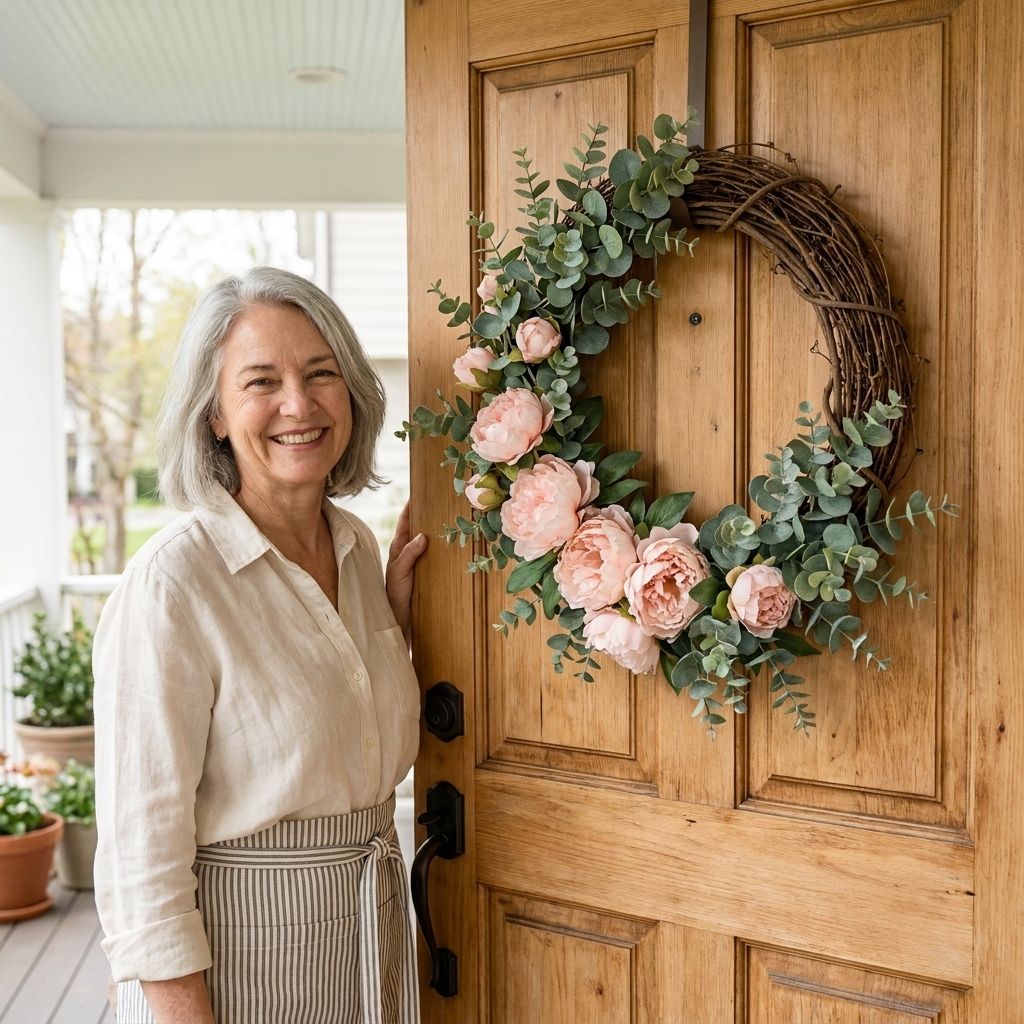
There is something about a spring wreath on a weathered front door that instantly says, come on in, kick your boots off. And if you are anything like me, you want that sweet, gathered-from-the-garden look without worrying about browning leaves or dropping petals all over the porch.
This eucalyptus-and-peony wreath is one of my favorite “looks real from the road” projects. We are using a rustic grapevine base, faux greenery, and just enough blooms to feel fresh, soft, and welcoming. I will walk you through it exactly the way I build them on my kitchen table, coffee in hand, glue strings everywhere.
What You’ll Need
You can absolutely make this work with what you already have in your stash. The list below is my reliable “full but not fussy” formula.
Time: about 30 to 60 minutes
Difficulty: beginner-friendly (just take your time with wiring)
Supplies
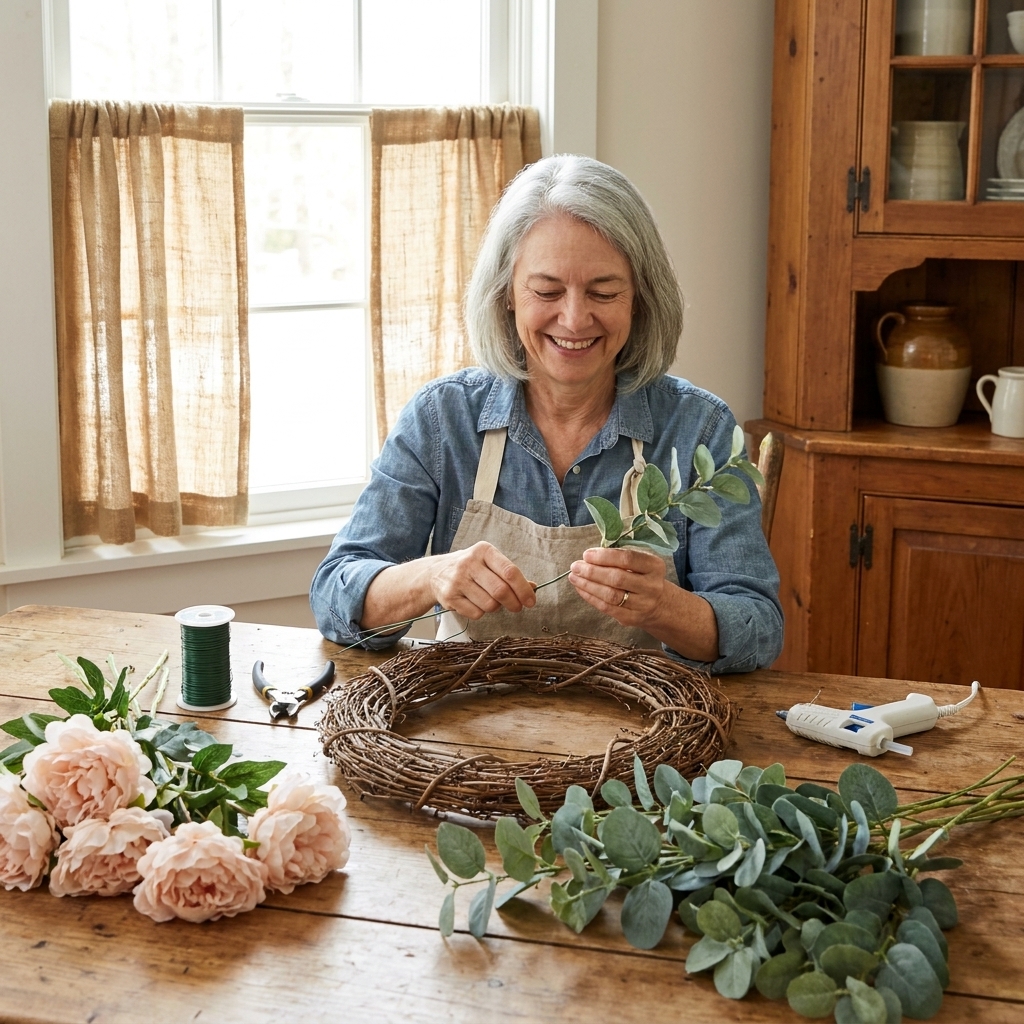
- Grapevine wreath base (14 to 18 inches is a great front door size)
- Faux eucalyptus stems (3 to 6 stems depending on fullness)
- Faux peonies (3 to 7 blooms, plus a couple buds if you have them)
- Faux filler (optional: lamb’s ear, small white blossoms, baby’s breath, or mini greenery picks)
- Floral wire (22 to 26 gauge) or pre-cut paddle wire
- Wire cutters
- Hot glue gun and glue sticks (optional but helpful)
- Ribbon (optional: linen, ticking stripe, or jute)
- Hanging method: wreath hanger, ribbon loop, or command-style outdoor hook
My favorite budget-friendly sourcing
I have found the best faux eucalyptus at craft stores in spring, and surprisingly good peonies at discount shops and seasonal aisles. If you can, choose stems with variation in leaf size and a slightly matte finish. Super shiny leaves are the quickest giveaway that something is faux.
Before You Start
Pick the front
Grapevine wreaths have a front and a back, even if they look similar at first. The front usually has the prettiest twists and fewer broken bits sticking out.
Quick check: set the wreath on the table, step back a few feet, and decide which side feels most balanced. That is your front.
Choose your fullness
- Airy and simple: greenery on one side with a small peony cluster
- Classic and full: greenery around about two-thirds of the circle plus a medium floral cluster
- Lush and garden-y: greenery almost all the way around, blooms tucked throughout
Step-by-Step Wreath
Step 1: Prep your stems
Cut stems down to workable sections. For eucalyptus, I like a mix of longer pieces (for shape) and shorter pieces (for filling gaps). For peonies, keep a little length so you can wire them in securely.
If your faux stems have stiff plastic “branches,” bend them gently to loosen things up. Real greenery is never perfectly straight.
Step 2: Arrange your design first
Before you attach anything, lay your eucalyptus on the wreath base where you think you want it. Start with your longest pieces first, letting them extend past the grapevine edges a bit. This gives that wild, freshly gathered look.
I usually build a base layer of eucalyptus in one direction, then tuck a second layer going slightly the opposite direction. That little cross-current is what makes it look natural.
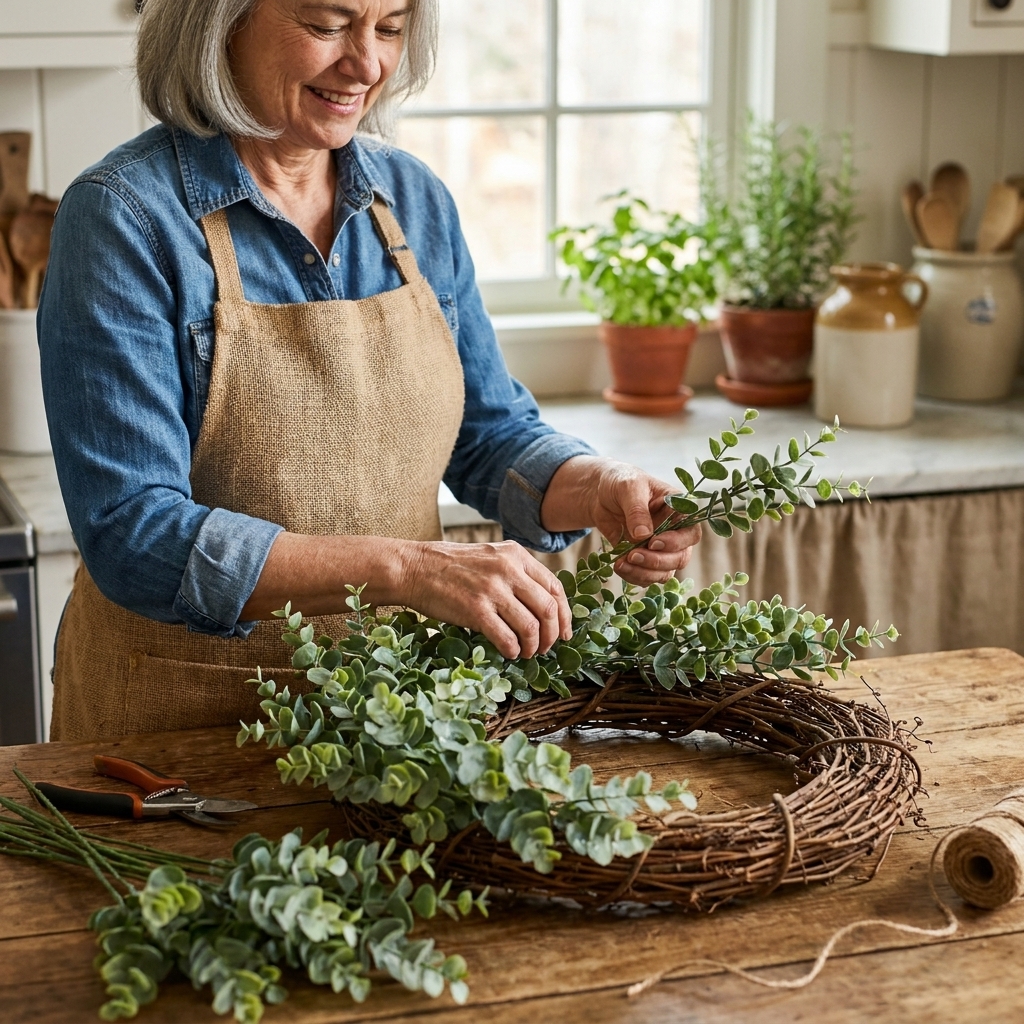
Step 3: Attach eucalyptus with wire (then spot-glue)
Once you like the placement, start wiring your eucalyptus to the grapevine. Tuck the wire down into the twists of the vine so it disappears.
- Wire is the workhorse: it is usually more secure than glue alone, especially if your wreath will be outside.
- Hot glue is the helper: I use a dab here and there to keep a stubborn stem from lifting.
Little tip from my old cottage days: when you think you have wired enough, give the wreath a gentle shake. If stems shift, add one more wire wrap. Wind is not polite.
Step 4: Build your peony cluster
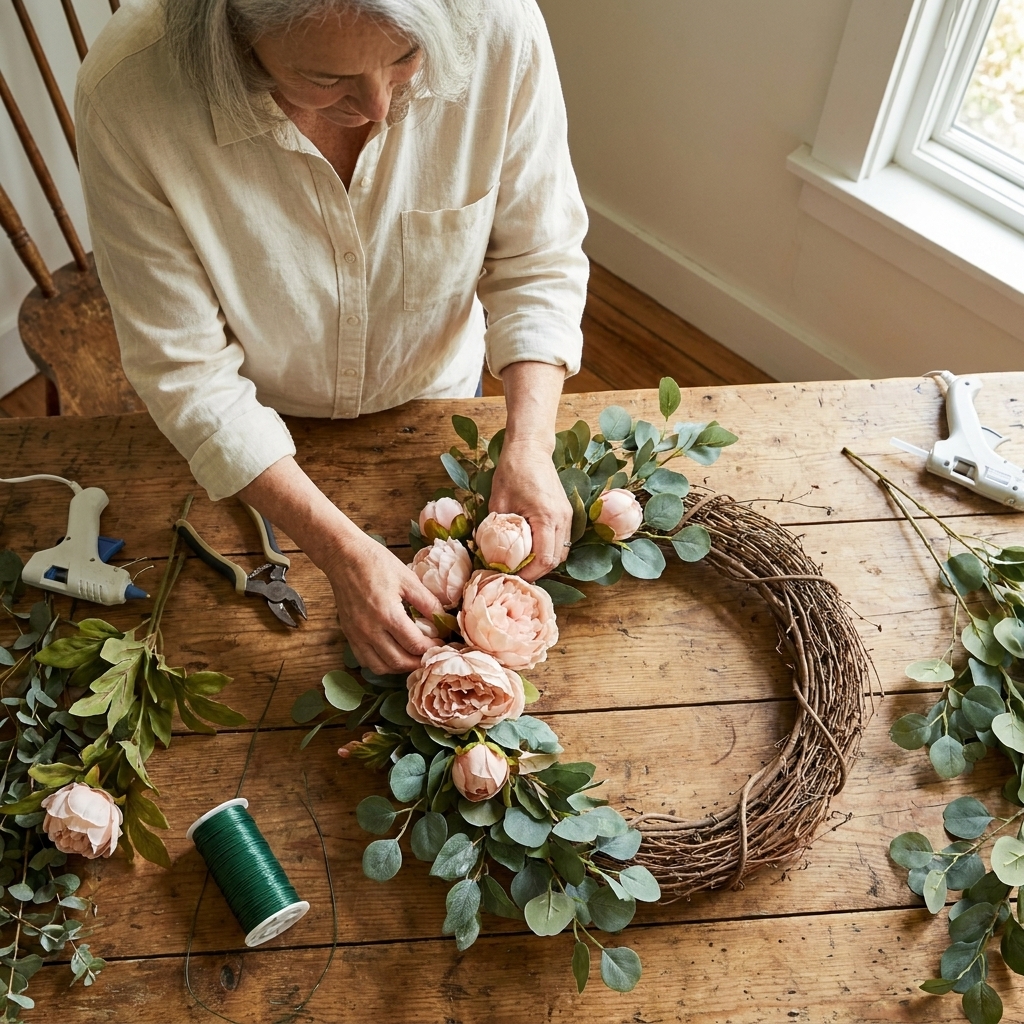
Peonies can look heavy if you space them evenly around the wreath. Instead, cluster them like a little bouquet that landed there.
Choose a spot, usually around the 4 o’clock or 8 o’clock area, and start with:
- One larger open peony as the focal point
- One to two medium blooms slightly above and beside
- A bud or smaller bloom tucked low or off to the side
Wire each bloom in, then step back. If it looks too perfect, it is. Turn one bloom slightly outward and angle another more toward the greenery.
Step 5: Fill gaps with small greenery
This is the part that makes the wreath look finished. Look for “holes” where you can see straight through to the door color. Add short eucalyptus pieces, lamb’s ear, or tiny blossoms in those spots.
Also, make sure you have:
- Some pieces reaching outward for movement
- Some pieces tucked inward into the grapevine for depth
- A mix of textures: round eucalyptus, soft lamb’s ear, delicate filler
Step 6: Add ribbon (optional)
If you love the look of a simple bow, keep it relaxed. A crisp, perfect bow can feel too formal for rustic style.
My favorites:
- Natural linen ribbon in oatmeal or soft sage
- Black ticking stripe for classic contrast
- Jute if you want something extra rustic
Wire the bow on, and use a tiny dot of hot glue only if needed. Let the tails hang unevenly for that casual “I just tied this with what I had” charm.
Make Faux Look Real
I am all about faux that does not scream faux. Here are my tried-and-true tricks:
- Use odd numbers of blooms: 3, 5, or 7 looks more natural than 4 or 6.
- Break up symmetry: let the greenery travel further on one side than the other.
- Hide mechanics: tuck wire ends deep into the grapevine twists.
- Mix finishes: one type of eucalyptus can look flat. Add a second green or a soft gray-green like lamb’s ear.
- Do the curb check: look at it from road distance. That is where it needs to read as full and balanced.
Hanging and Door Tips
Protect your door
Grapevine can scratch painted doors. If your door is freshly painted or you just want to be careful, tie a short piece of felt or a soft furniture pad to the back where it touches.
Keep it from swinging
If your porch gets wind, run a thin ribbon or clear fishing line from the bottom of the wreath to a small removable hook on the door. It is basically a seatbelt for your wreath, and it keeps it centered.
Hook and hardware notes
If you are using a command-style hook, make sure it is truly outdoor-rated and weight-rated for your wreath. Grapevine and faux florals can be heavier than they look. If you have a glass storm door, keep the wreath slim enough that the door can close without rubbing.
Sun fade and weather
Even faux can fade in direct sun. A covered porch is ideal. If your door bakes in afternoon light, rotate the wreath periodically so one side does not get sun-bleached first.
Easy Variations
Once you know the basic structure, you can swap florals season after season without rebuilding the whole thing.
- Soft spring: blush peonies + white filler + sage eucalyptus
- Classic neutral: white peonies + lamb’s ear + black ticking bow
- Early summer: peonies + faux lavender tucked into the greenery
- Simple minimal: eucalyptus only with a linen ribbon

Troubleshooting
My wreath looks flat
Add a few longer eucalyptus pieces that extend beyond the grapevine edge, then tuck shorter pieces underneath for layering. Depth is what makes it look expensive.
The blooms feel too bulky
Pull one peony out and replace it with a bud or smaller flower. You can also angle blooms outward instead of pointing them straight forward, which helps them sit more naturally.
Stems keep popping out
Use wire first, then glue. If you are only using glue on grapevine, it can release with temperature changes.
It looks uneven on the door
Your hanger might be sitting off-center. Try tying a ribbon loop directly to the wreath frame so you can control exactly where it hangs.
Care and Storage
This wreath can absolutely be a multi-season keeper if you store it well.
- Dust it gently with a soft paintbrush or a hair dryer on cool, low setting.
- Store in a wreath bag or a large plastic bin standing upright.
- Avoid crushing: do not stack heavy bins on top of it.
- Keep it dry: a damp basement can warp the grapevine and loosen glue.
Quick FAQ
What size wreath looks best on a front door?
For most standard doors, a 16 to 18 inch grapevine base creates a wreath that feels generous without swallowing the door. Just remember the finished wreath is usually larger once you fluff and let greenery extend. A 16 to 18 inch base often finishes closer to about 20 to 24 inches overall.
Can I use real eucalyptus instead of faux?
You can, but it will dry and shed over time. Dried eucalyptus can be beautiful, just more delicate. For a truly long-lasting wreath that can handle porch life, faux is the easy win.
Do I need a bow?
Nope. The greenery and peonies are enough. A bow is just a little extra personality if you want it.
Safety note
Hot glue is no joke, and clipped wire ends are sneaky. Keep a little dish for wire scraps, watch your fingertips, and tuck any sharp ends deep into the grapevine so nothing can scratch you (or catch a sleeve) later.
If you make this wreath, I hope you let it be imperfect in the best way. A little twist here, a leaf sticking out there, that is what makes it feel like something you gathered on a slow spring morning. And that cozy, lived-in feeling is always the goal around here.