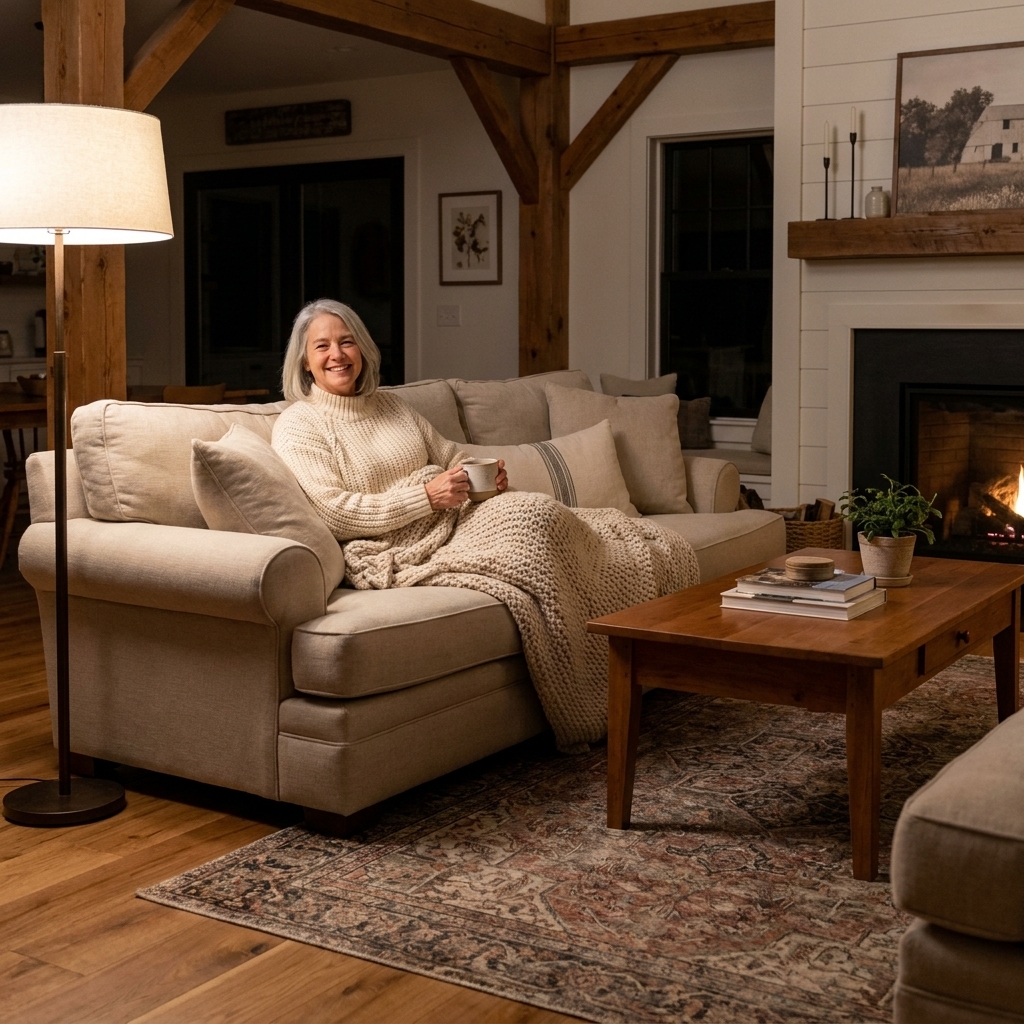
I grew up in a little upstate New York farming town where “good bones” was basically a love language. My grandma could walk into a drafty parlor at an estate sale and tell you exactly where the rug should land, just by looking at the furniture legs. Years later, when I was fixing up my own 1920s cottage on a shoestring, I learned the hard way that a rug that’s even a size too small can make a cozy farmhouse living room feel choppy and stingy, even if every other detail is right.
So let’s make this simple. Below are the rug sizing rules I use in real homes, plus how much bare floor to leave, how different farmhouse-friendly materials behave, and an easy painter’s tape trick that saves you from buying the wrong size.
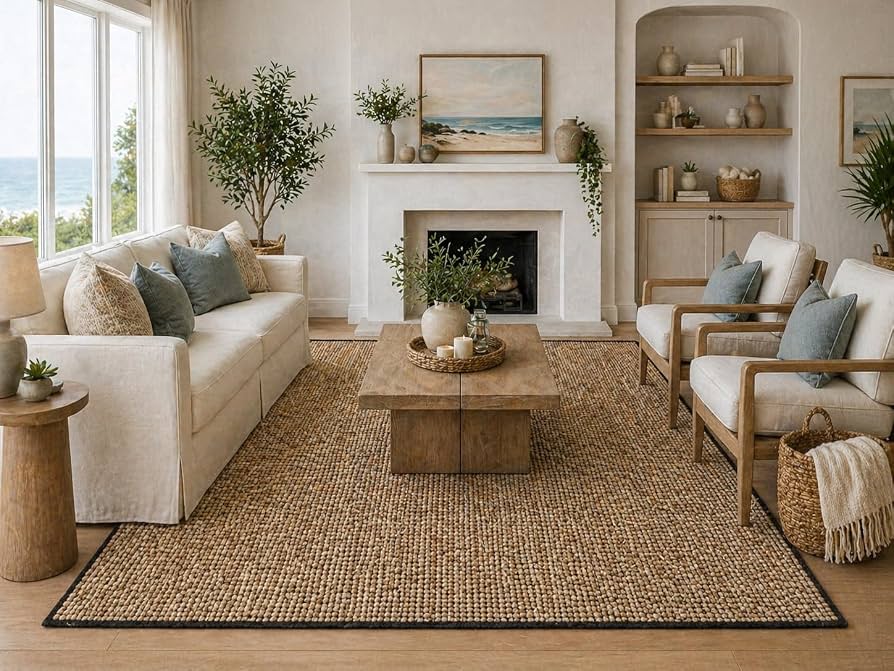
The two farmhouse rug rules that fix most layout problems
Rule 1: Anchor the front legs
In a classic sofa-and-chair grouping, your rug should catch the front legs of every main seat (sofa and any chairs facing it). This keeps the conversation area feeling like one “room” instead of floating pieces.
- Best look: front legs on the rug with 6 to 12 inches of rug under the legs.
- Works in tight rooms: front legs just barely on the rug (about 2 to 4 inches).
- Avoid: a rug that sits completely in front of the seating. That’s the #1 “too small” giveaway.
Rule 2: Leave a clean border of bare floor
Farmhouse spaces love breathing room. You want a border of visible flooring around the edges so the rug looks intentional, not wall-to-wall.
- Standard rooms: a common target is 8 to 18 inches of bare floor between rug and walls.
- Small rooms: I usually aim for 6 to 12 inches. If you need a bigger rug to keep chair legs on, it’s fine to go a little tighter on one side or widen to up to about 18 inches on another. Comfort beats perfect symmetry.
- Open plan: the “border” is less about walls and more about clear walkways. Many homes feel comfortable around 30 to 36 inches, but smaller apartments may do fine with less, and accessibility needs may require more.
Fast measuring method with painter’s tape
If you do one thing before ordering a rug, do this. It’s the closest thing to trying the rug in your room without hauling one home.
- Decide your layout first. Place the sofa and chairs where they actually work for walking, TV viewing, and traffic flow.
- Pick the rug’s “job.” In most farmhouse living rooms, the job is: front legs of sofa and chairs on the rug, coffee table centered. In a larger room, the job might be: all legs on for chairs (or even the sofa) so the whole setup feels extra grounded.
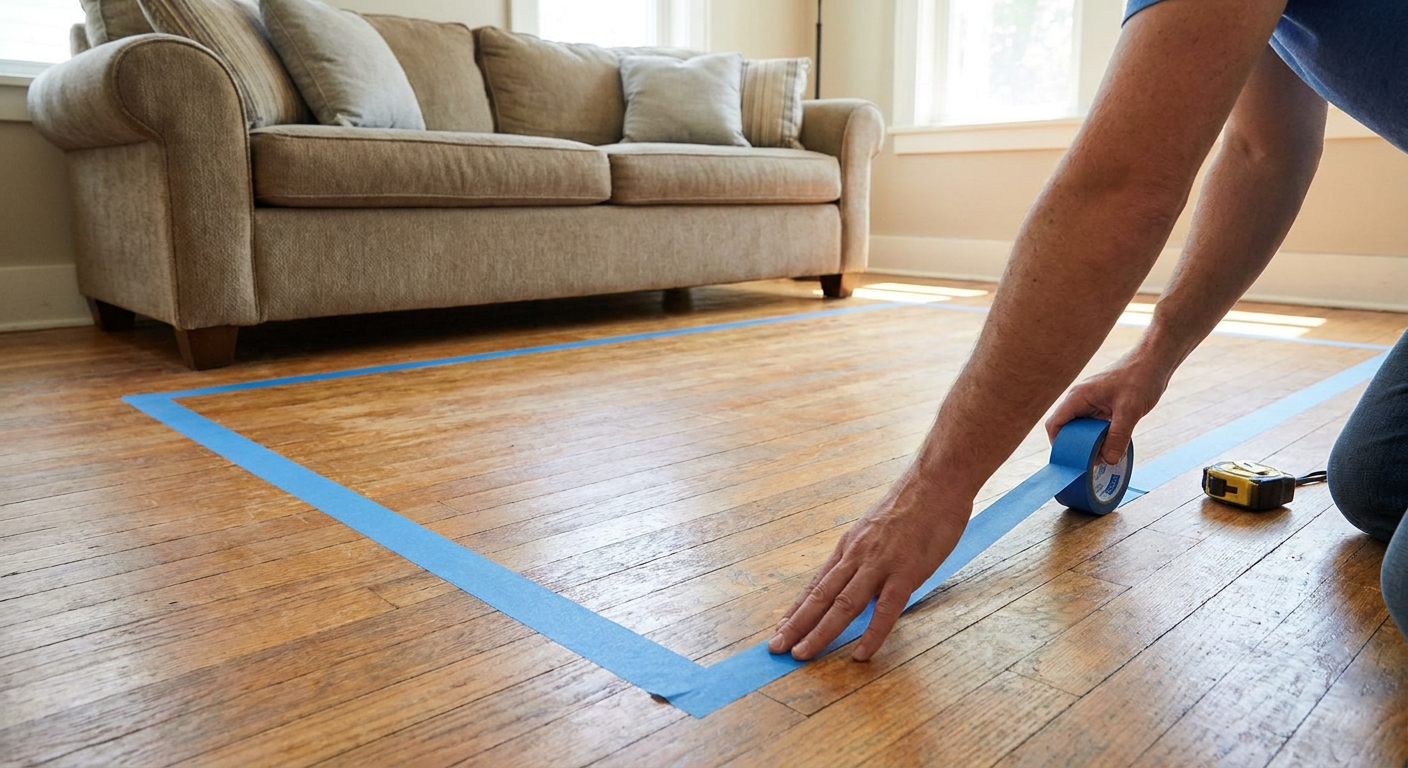
- Tape the rug outline. Use painter’s tape to mark a 5x8, 8x10, or 9x12 rectangle on the floor.
- Make sure it’s square. Measure each side to confirm your lengths, then check the corners. If you want to be extra sure, measure corner-to-corner diagonals. If the diagonals match, your outline is square.
- Test the legs. Slide chairs forward to their “in use” position and confirm the front legs stay on the tape.
- Stand in the walkways. Make sure you can walk around the grouping without tight squeezes. In many homes, 30 to 36 inches is a comfortable target for main paths, but adjust for your space and needs.
Tip from too many cottage mistakes: keep the tape down for a day. Live with it. If you’re constantly stepping over the line or your chair legs are landing off the tape, you just saved yourself a return.
What a 5x8 rug fits
A 5x8 is the smallest rug size I personally like to use in a living room. It can work beautifully, but only when the room and furniture are scaled for it. In a very tiny sitting area, a 4x6 can make sense, but it’s easy to end up with that “floating furniture” look if you’re not careful.
Best for
- Small living rooms where the seating is compact (like an apartment sofa or a petite loveseat).
- Minimal groupings (sofa plus one chair, or sofa alone with a coffee table).
- Layering under a larger natural fiber base (more on that below).
Placement rules for a sofa-and-chair grouping
- Front legs only: aim to get the sofa’s front legs on the rug. If you have chairs, choose slim chairs and tuck their front legs on too.
- Coffee table: keep the coffee table fully on the rug, with about 14 to 18 inches between table and sofa for leg room. In extra-tight rooms, a little less can work as long as it’s still comfortable for your household.
- Typical bare floor border: in a small room, 6 to 12 inches often looks balanced. If your room is narrow, you may end up with an uneven border. That is normal in older homes and small cottages.
Common 5x8 problem
If your chairs sit completely off the rug, the conversation area looks split in half. In that case, either go up to 8x10 or use a farmhouse-friendly trick: layer a 5x8 vintage rug on top of a larger jute so the seating can anchor on the bottom layer.
What an 8x10 rug fits
If you told me I could only keep one rug size knowledge nugget forever, it would be this: an 8x10 solves most living rooms. It’s large enough to anchor a standard sofa-and-chair setup without swallowing the whole room.
Best for
- Standard sofas (roughly 84 to 96 inches long) with one or two accent chairs.
- Most farmhouse layouts where you want cozy, grounded seating but still see a frame of wood floor.
- Open plans where you’re defining the living area inside a larger space.
Placement rules for a sofa-and-chair grouping
- Sofa: place the rug so the sofa’s front legs sit 6 to 12 inches onto the rug.
- Chairs: pull chairs forward so their front legs are also on the rug when someone sits. This is what makes the grouping feel connected.
- Coffee table: keep it fully on the rug, centered.
- Typical bare floor border: a common target is 8 to 18 inches between rug and walls. If your room is narrow, don’t force symmetry. It’s fine if one side has a smaller border as long as walkways make sense.
A farmhouse note: an 8x10 under a warm, worn-in vintage rug pattern is one of the easiest ways to make new upholstery look less “straight from the showroom.”
What a 9x12 rug fits
A 9x12 rug is what I reach for when the living room is larger, the seating is deeper, or the space is open to the kitchen and dining and needs a strong visual anchor.
Best for
- Large rooms where an 8x10 looks a little like a postage stamp.
- Sectionals or deep sofas paired with multiple chairs.
- Open-plan great rooms where you want the living area to read as a defined zone.
Placement rules for a sofa-and-chair grouping
- Front legs plus breathing room: a 9x12 usually allows the sofa and chairs to sit more comfortably on the rug without perching at the edges.
- Optional upgrade: in bigger rooms, you can place all legs of chairs on the rug and still have space for movement.
- Typical bare floor border: if the room allows, aim for 12 to 24 inches from rug edge to wall. In open plans, prioritize clear pathways around the seating zone over matching borders.
If you’re deciding between 8x10 and 9x12 in an open plan, my farmhouse rule is: choose the larger rug if it helps the seating feel finished and keeps chair legs from slipping off the edge.
Sectionals and oversized rugs
Farmhouse great rooms love a sectional, and sectionals love a rug that is not timid.
- For most sectionals: a 9x12 is often the sweet spot so at least the front legs of the sectional and any nearby chairs can sit on the rug.
- If the sectional is extra large: you may be happier jumping to a 10x14 (if your room can spare it) so the rug does not look like it’s shrinking away from the corners.
- All front legs vs all legs: I aim for all front legs on as the baseline. “All legs on” is a lovely upgrade if you have the space and want a more luxurious, lounge-y feel.
How material changes the plan
In farmhouse style, rugs are not just color. They are texture, weight, and practicality. And those things can nudge your sizing and placement choices.
Jute rugs
Jute is a space-maker. Its simple weave reads calm and continuous, which helps small rooms feel less busy and open plans feel more cohesive.
- In a small room: go as large as you reasonably can while keeping a slim floor border. A bigger jute rug can make the room look wider, and it’s forgiving if the edge gets close to a wall.
- In an open plan: jute is excellent for defining a zone. I like an 8x10 or 9x12 base so all the main seating touches it.
- Practical note: jute can shed and it does not love moisture. Keep it out of splash zones and plan on regular vacuuming.
- Farmhouse layering tip: use jute as the bottom layer, then place a smaller vintage rug on top for softness and pattern.
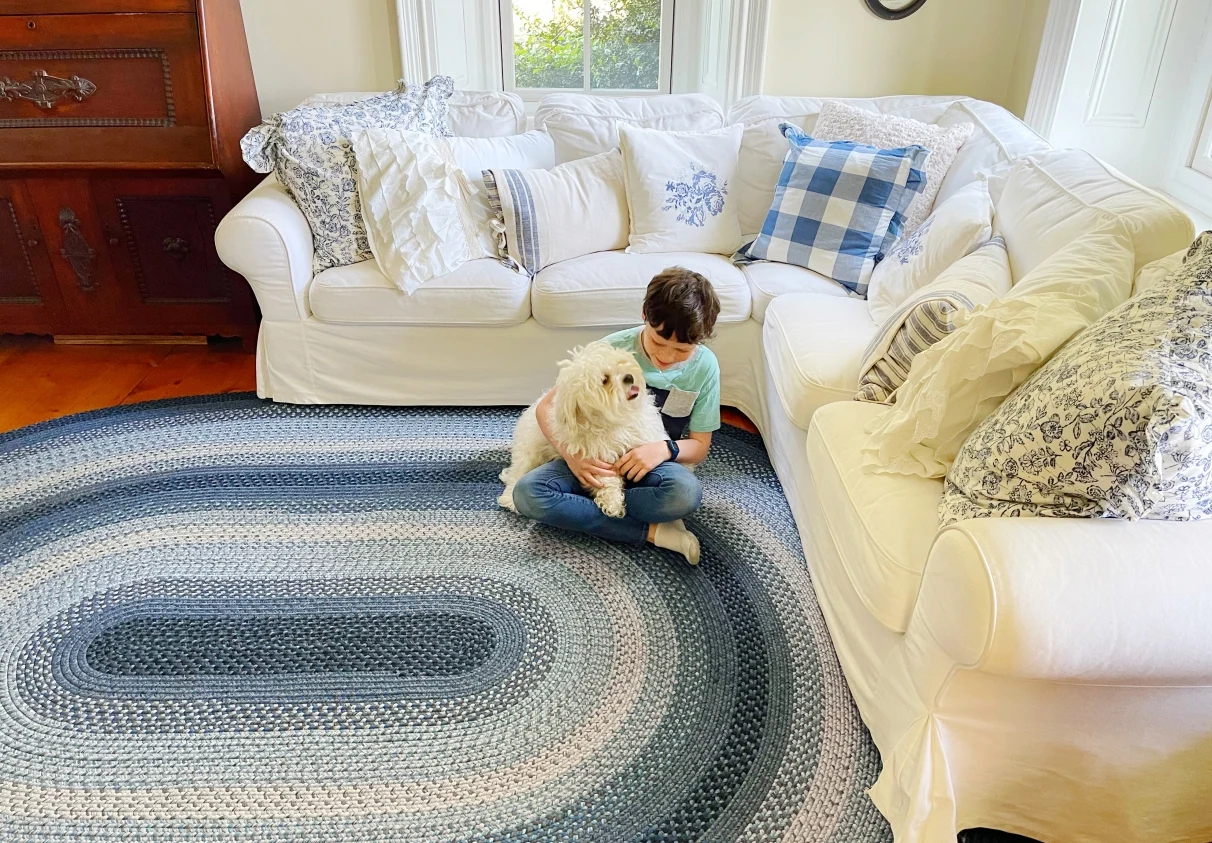
Braided rugs
Braided rugs feel homey and traditional, but visually they can be busy because of the rings and color changes. That isn’t bad. It just affects scale.
- In a small room: consider sizing up so the braid pattern does not look like a tiny target in the middle of the floor.
- In an open plan: braided rugs can beautifully warm up big spaces, but they look best when the furniture clearly anchors them. An 8x10 is often the minimum for a sofa-and-chairs grouping.
- Practical note: braids can be a bit bulky, and chair legs can catch on the texture. A good pad helps.
- Placement note: because braided rugs have a distinct edge, you will notice chair legs falling off. Use painter’s tape to confirm chairs land where you want.
Vintage rugs
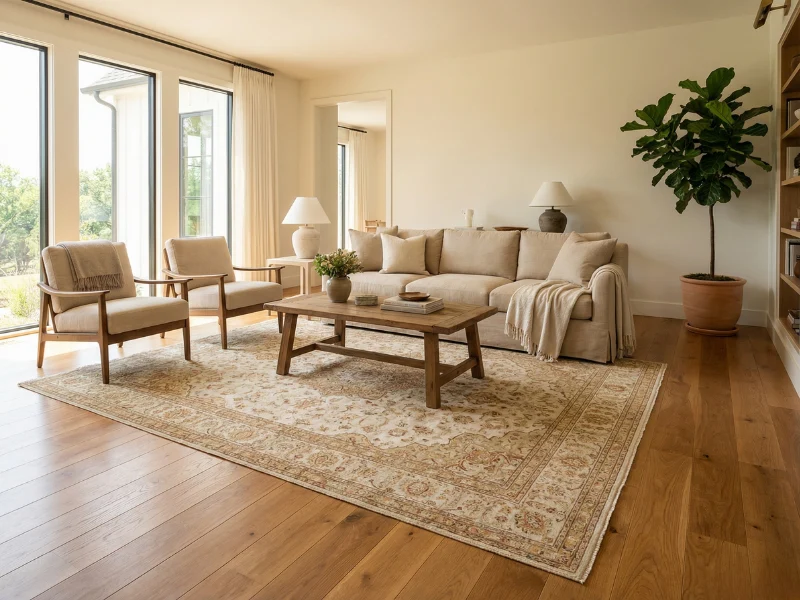
Vintage rugs are forgiving in the best way. Faded patterns and low contrast hide everyday life, and that “already lived in” look is pure farmhouse magic.
- In a small room: a vintage rug can be the star without taking over. If you are using a 5x8, choose a pattern that has some lightness to it so the room does not feel chopped.
- In an open plan: vintage rugs define the living zone strongly. If your furniture is larger scale, jump to 9x12 so the rug does not look like it’s shrinking away from the seating.
- Practical note: many vintage-style rugs are low-pile and easy to live with. True vintage wool can be wonderfully durable, but use a pad to reduce slipping and protect the backing.
- Layering tip: a slightly smaller vintage rug layered on a larger jute base is one of my favorite ways to make a builder-basic room feel collected.
Do not skip the rug pad
A rug pad is not exciting, but it is one of those quiet farmhouse basics that makes the whole room feel better.
- Grip: helps keep jute, braided, and layered rugs from creeping.
- Comfort: adds softness underfoot, especially for flat weaves.
- Protection: helps protect both your floor and the rug backing.
- Fit: trim the pad so it sits just inside the rug edges. If the pad sticks out, you will see it and feel it.
Quick layout checks
- Coffee table spacing: 14 to 18 inches from sofa is a common comfort range. Go tighter only if you need to, and go wider if you want more leg room.
- Chair usability: chairs should still sit on the rug when pulled forward to actually use.
- Walkways: many homes feel comfortable around 30 to 36 inches for main paths, but adjust for small spaces, door swings, and accessibility needs.
- Edge breathing room: in standard rooms, 8 to 18 inches of bare floor around a rug often looks right. In small rooms, 6 to 12 inches is a solid starting point.
If you are wavering between sizes, farmhouse rooms almost always benefit from the slightly larger rug. It makes the seating feel anchored and welcoming, like you meant for everyone to kick off their shoes and stay awhile.
Rug size cheat sheet
- Small sofa or loveseat, compact seating: often 5x8
- Standard 84 to 96 inch sofa plus 1 to 2 chairs: usually 8x10
- Large room, deep sofa, or sectional: commonly 9x12
- Extra large sectional or great room that swallows rugs: consider 10x14
FAQ
Should the rug go under the sofa?
Yes, at least under the front legs. It’s the quickest way to make the arrangement feel cohesive and not like separate pieces.
How far should the rug extend past the sofa?
A common target is 6 to 12 inches of rug showing past each side of the sofa. If the room is tight, even a small reveal is better than none.
What if my living room is an odd size?
That’s exactly when painter’s tape shines. Tape out the size you think you want, then check chair legs, coffee table placement, and walkways. If something feels fussy or pinched, adjust the tape and re-measure.